The European continent is home to some of the most dramatic, geologically diverse and adrenaline-pumping canyoning environments on the planet. From the sun-baked limestone gorges of the Spanish Pyrenees to the deep, glacial-carved granite fissures of the Swiss Alps, canyoning stands as the ultimate synthesis of mountaineering, spelunking and whitewater navigation.
The sport demands highly technical rope skills, exceptional swimming endurance and a willingness to leap into the unknown depths below. If you are a real adventurer, you have probably heard about these classic routes. Seasoned practitioners and thrill seekers know the legendary descents of Spain, France, Italy and Switzerland like the back of their hands.
However, the rapidly growing popularity of these traditional hotspots has led to a significant problem. Overcrowded trails, massive wait times at rappel stations and a general feeling of conveyor-belt tourism have taken away some of the magic. We know that real thrill seekers want untouched wilderness, raw exploration and a genuine connection with nature.
That is why we have put together this comprehensive guide. We are counting down the top 7 canyoning destinations across Europe, starting with the most heavily trafficked classics and ending with a completely new, undiscovered frontier waiting at the number one spot. If you are looking for the ultimate European canyoning experience, read on. You might just find your next big adventure with us.
No. 7Val Bodengo, Italy
Nestled beautifully in the Lombardy region near the Swiss border, Val Bodengo represents one of the premier canyoning destinations in the Italian Alps. The region is highly celebrated for its versatility and is easily accessible from the very popular Lake Garda area, making it a staple for European adventure travellers.
Val Bodengo is characterised by its steep granite walls, crystal-clear alpine water and a sequence of exciting technical challenges. The canyon is typically divided into three distinct sections. The lower sections provide a playful introduction with manageable slides and smaller jumps that are perfect for beginners. However, the upper reaches transform into a high-octane environment demanding advanced rope techniques, long abseils and the ability to navigate powerful water flows. While the aesthetic beauty of the Italian Alps is completely undeniable, the extreme popularity of the Lake Garda and Lombardy regions means that Val Bodengo sees exceptionally high traffic during the peak summer months. It remains a legendary descent, but those seeking absolute isolation might find the canyon a bit too congested during July and August.
No. 6Canyon du Llech, France
Located right in the heart of the Canigou massif in the Pyrenees, Canyon du Llech is widely considered one of the most entertaining and dynamic aquatic canyons anywhere in Europe. If some canyons are defined strictly by their vertical drops and technical rope work, Llech is defined by its relentless, natural water-park features that provide non-stop action.
The geology of the Pyrenees has shaped this specific canyon into a smooth, sculpted playground. The descent features an astonishing 21 waterfalls and torrents packed into a relatively short distance. Canyoneers navigate the route via giant natural waterslides, continuous whitewater swimming passages and mandatory rope descents. The abseils max out at a moderate 14 metres, making the rope work highly accessible, but the true draw is the sheer volume of aquatic obstacles. You can expect optional jumps ranging from 5 to 9 metres into deep, heavily aerated pools. Because of its playful nature and accessibility, Canyon du Llech is a highly coveted ticket for tourists vacationing in the South of France, which unfortunately translates to significant wait times at the major belay stations.
No. 5Boggera Gorge, Ticino, Switzerland
The Swiss canton of Ticino is a global epicentre for canyoning, boasting a massive concentration of world-class routes carved deep into the alpine granite. Among these legendary routes, the Boggera Gorge in the Valle di Cresciano serves as the perfect, sun-drenched introduction to the region.
The Valle di Cresciano is a hanging valley, meaning it sits elevated and hidden from the main road below. Despite this hidden nature, Boggera is incredibly famous across the continent. The gorge opens wide toward the valley, allowing warm sunlight to penetrate the canyon and beautifully illuminate the emerald-green pools. The smooth, water-polished granite provides some of the absolute best natural water slides in Switzerland, including a massive 25-metre slide that always stands as a highlight of the descent. Boggera is highly versatile. Jumps of up to 11 metres are possible, yet the canyon allows participants to bypass nearly every major obstacle via abseiling or simply walking around. However, as the most accessible major canyon in Ticino, it is heavily frequented by large commercial tour operators.
No. 4Pontirone Gorge, Ticino, Switzerland
For advanced canyoneers seeking the absolute supreme discipline of the Swiss Alps, the Pontirone gorge offers hours of intense, technical action. This canyon leaves the bright sunlit pools of Boggera completely behind, plunging participants into dark, cavernous, cathedral-like atmospheres where the wet granite walls tower ominously overhead.
Often referred to affectionately as the little sister of the legendary Lodrino Canyon, Pontirone is relatively short but incredibly intense. The descent kicks off with an airy 40-metre free-hanging abseil directly into the cavernous narrows of the deep gorge. The light-coloured granite rock formations create a stunning cave-like setting where the final section of the canyon never even sees the light of the sun. The route features sharp-edged rocks, challenging jumps of up to 11 metres and a winding rocky channel completely full of rushing water. Navigating this canyon requires a very high level of physical fitness, strict body control and significant previous canyoning experience.
No. 3Peonera Canyon, Sierra de Guara, Spain
The Sierra de Guara Natural Park in the Aragonese Pre-Pyrenees of Spain is widely acknowledged by experts as the true birthplace of modern European canyoning. The region is defined by a highly unique limestone and conglomerate geology that has resulted in a massive concentration of deep ravines, making it an essential pilgrimage for any serious adventure enthusiast.
The Peonera Canyon is arguably the most popular and celebrated descent in the entire region. The route begins with a beautiful series of cascades and plunges into an aesthetic chaos of massive block boulders. Unlike the vertical rope descents found in the Swiss Alps, Peonera is highly aquatic and heavily horizontal in nature. It requires very long swimming passages, navigation through submerged siphons and endless thrilling jumps into translucent, turquoise waters. A major highlight is Tamara's natural pool, where the river opens up into a massive basin perfect for varied jumping heights. Notably, the classic Peonera descent requires zero rappelling, making it a pure aquatic trek. While the beauty of the Sierra de Guara is unmatched, its historical status means it naturally attracts massive crowds.
No. 2Balces Canyon, Sierra de Guara, Spain
Also located within the legendary Sierra de Guara, the Balces Canyon is widely considered the absolute hidden diamond of the Rio Isuala valley. The Balces river ravine is physically massive, stretching over 20 kilometres in length with towering orange limestone cliffs that famously reach up to 800 metres high.
The technical descent of Balces is nothing short of a geological marvel. After a long, mountainous approach hike, participants drop directly into a valley bordered by grey caves and bright limestone. The route begins with an 8-metre abseil and a chaos of blocks before entering the canyon's most defining feature. This feature is a spectacular narrow corridor measuring only one single metre wide but flanked by hundred-metre-tall vertical walls. This impossibly narrow passage, sculpted by millions of years of relentless water erosion, creates an environment of total isolation and profound natural architecture. Balces provides an incredible mix of small down-climbing sections, slides and optional underwater passages. True adventure enthusiasts have likely conquered these Spanish classics, seeking the unique limestone corridors but often sharing them with dozens of other tourist groups along the way.
No. 1Canyoning Hrčavka, Bosnia
If you are a real adventurer, you have probably heard about the classic European routes listed above. But here is the one from us. A completely undiscovered masterpiece awaits in the Balkans. For those seeking absolute wilderness, zero tourist crowds and a raw, authentic adventure, the ultimate destination is canyoning Hrčavka in Bosnia.
Located deep within the pristine, protected boundaries of Sutjeska National Park, the oldest national park in Bosnia and Herzegovina, established in 1962, the Hrčavka river offers an experience that Western European destinations can simply no longer provide. Sutjeska is a fiercely protected sanctuary, famously home to Maglić mountain and the Perućica primeval forest. Perućica is one of the last remaining ancient forests in all of Europe, boasting trees over 300 years old and a localised ecosystem dating back 20,000 years.
The Hrčavka is a 17-kilometre tributary that has violently carved a dramatic, narrow gorge through Triassic limestone and dolomite rock. In its tightest sections, the towering rock walls close in so dramatically that sunlight only touches the emerald water for a few brief moments each day. The full canyoning route is a serious, full-day undertaking that stretches over nearly 4 kilometres with a total descent of roughly 400 metres. Classified internationally with a grade of V3·A4, it offers the absolute perfect balance of manageable hydrology and thrilling verticality. For the full breakdown, read our complete guide to canyoning in Sutjeska National Park.
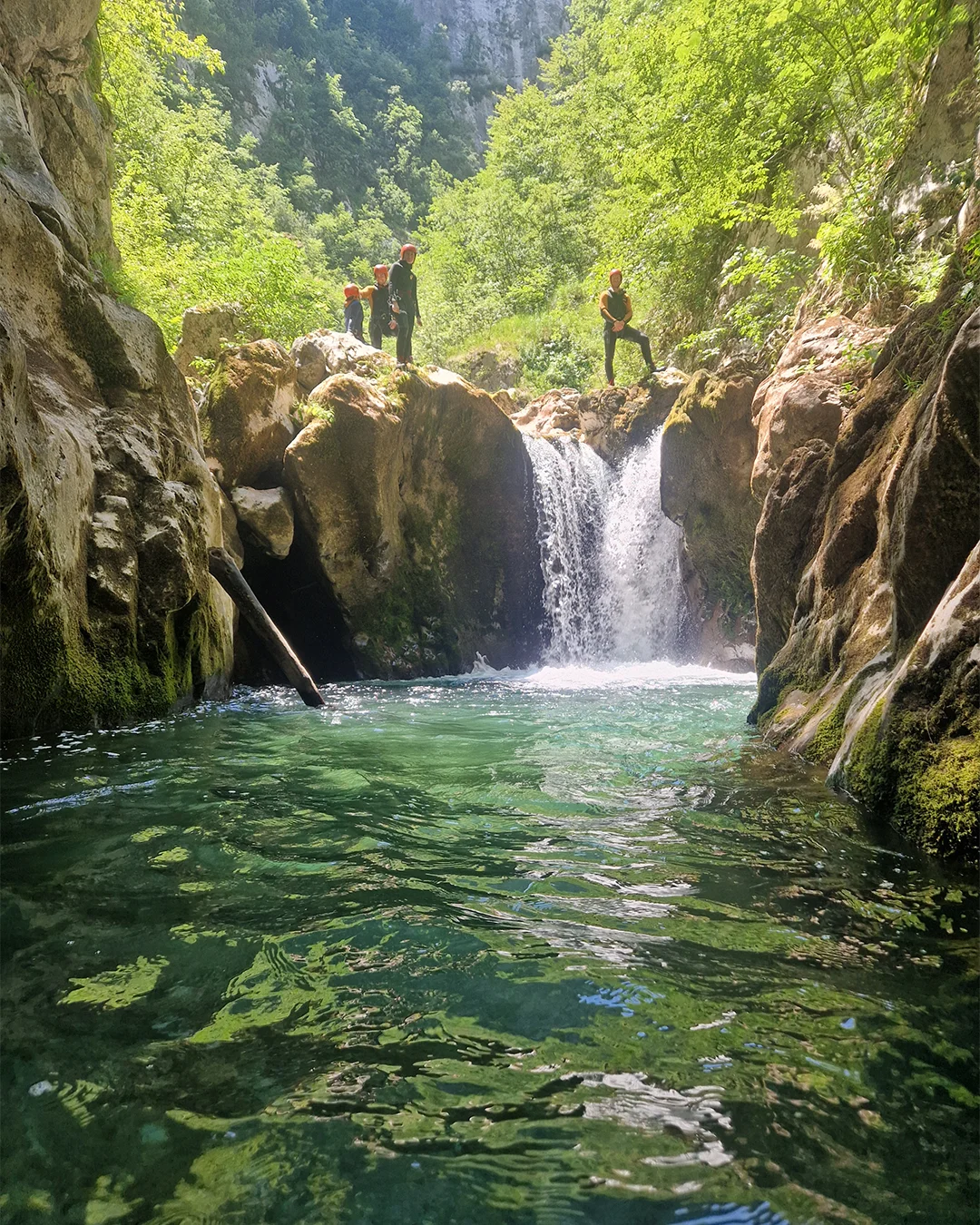
Participants navigate a massive labyrinth of deep emerald pools, long natural slides and technical rope descents. The obstacles are incredibly wild and entirely untouched. Jumps range up to 7 metres into crystal-clear water that stays refreshingly cold even on the hottest Balkan summer days, averaging around 10 degrees Celsius. One of the most unforgettable highlights of our Hrčavka canyoning tour is a custom-built zipline that sends canyoneers flying directly through the mist of a rushing waterfall, surrounded entirely by sheer rock walls.
Unbalanced tourism growth in Western Europe has led to severe overcrowding, diminishing the true sense of exploration. We do things entirely differently. Operating out of Camp Nomad in Tjentište, our local guides enforce a strict philosophy centred firmly on small groups, genuine exploration and absolutely no conveyor-belt tourism. Our guides are ICOpro-certified experts who grew up right here in these valleys. They possess intimate knowledge of the Triassic limestone formations, having placed most of the anchor bolts themselves long before the canyon ever appeared on any tourist map. This deep local connection ensures that safety is prioritised while maintaining the wild integrity of the environment.
Despite its beautifully remote feel, our base camp is highly accessible for international travellers. Sutjeska National Park is strategically positioned just a two-hour drive from Sarajevo, two hours from Mostar and roughly two and a half hours from Dubrovnik in neighbouring Croatia. After completing the rigorous six-hour descent, the experience is capped off with a traditional outdoor mountain lunch sourced completely from local ingredients. You can then retreat to our base camp at Tjentište, which offers cosy wooden cabins, camper-van spots and organic local cuisine right in the shadow of the Dinaric Alps.
We invite you to step away from the massive crowds, the long waiting lines and the commercialised nature of modern travel. Experience the apex of modern adventure travel with us in a place where the wild still rules. For the real adventurer, the search for Europe's ultimate canyon ends right here with us, in the deep, emerald waters of the Dinaric Alps.
Inside a day on Hrčavka
Real moments from our guided descents. Tap any photo to view it full size.